
Quick answer
Yapahuwa is a rock fortress in Sri Lanka's North Western Province, between Kurunegala and Anuradhapura. In the 13th century, it was briefly the royal capital, and the Sacred Tooth Relic was kept here. Its highlight is a steep, ornate stone staircase guarded by carved lions, which leads to the ruins of the Tooth Relic temple. You can then climb to the summit for wide views. A visit takes about two hours. Yapahuwa is much quieter than Sigiriya, and it fits easily into a drive between Colombo or Negombo and the Cultural Triangle.
If you love ancient sites but would rather avoid the crowds, Yapahuwa is one of Sri Lanka's hidden gems. The carved stone staircase is among the finest examples of ancient stonework on the island, and on most days you will share it with only a handful of other visitors. This guide explains Yapahuwa's history, what to see, how to get there and how to fit it into your trip.
Yapahuwa at a glance
| Location | Near Maho, Kurunegala District, North Western Province |
| Type | Rock fortress and ancient royal capital |
| Period | 13th century |
| Known for | The carved stone staircase and lion sculptures |
| Time needed | About 2 hours |
| Best time of day | Early morning or late afternoon |
The history of Yapahuwa
In the 13th century, Sri Lanka's kings faced invasions from South India, and the old capital of Polonnaruwa had been abandoned. The capital moved several times to places that were easier to defend.
King Bhuvanekabahu I made Yapahuwa his capital in the late 13th century. He fortified the great rock with walls and moats and built a temple for the Sacred Tooth Relic, the symbol of royal power in Sri Lanka. According to the chronicles, after his death the fortress was captured by an invading army from South India, and the Tooth Relic was taken away to India, before being brought back to Sri Lanka by a later king. Yapahuwa was then abandoned as a capital, and Buddhist monks later lived among the ruins.
Today, Yapahuwa is a protected archaeological site, and a working Buddhist temple sits at the foot of the rock.
What to see at Yapahuwa
The outer defences
As you approach the rock, you pass the remains of the old ramparts and moats that once protected the royal city. They are now mostly grassy banks and ditches, but they give a sense of how strongly the fortress was defended.
The stone staircase
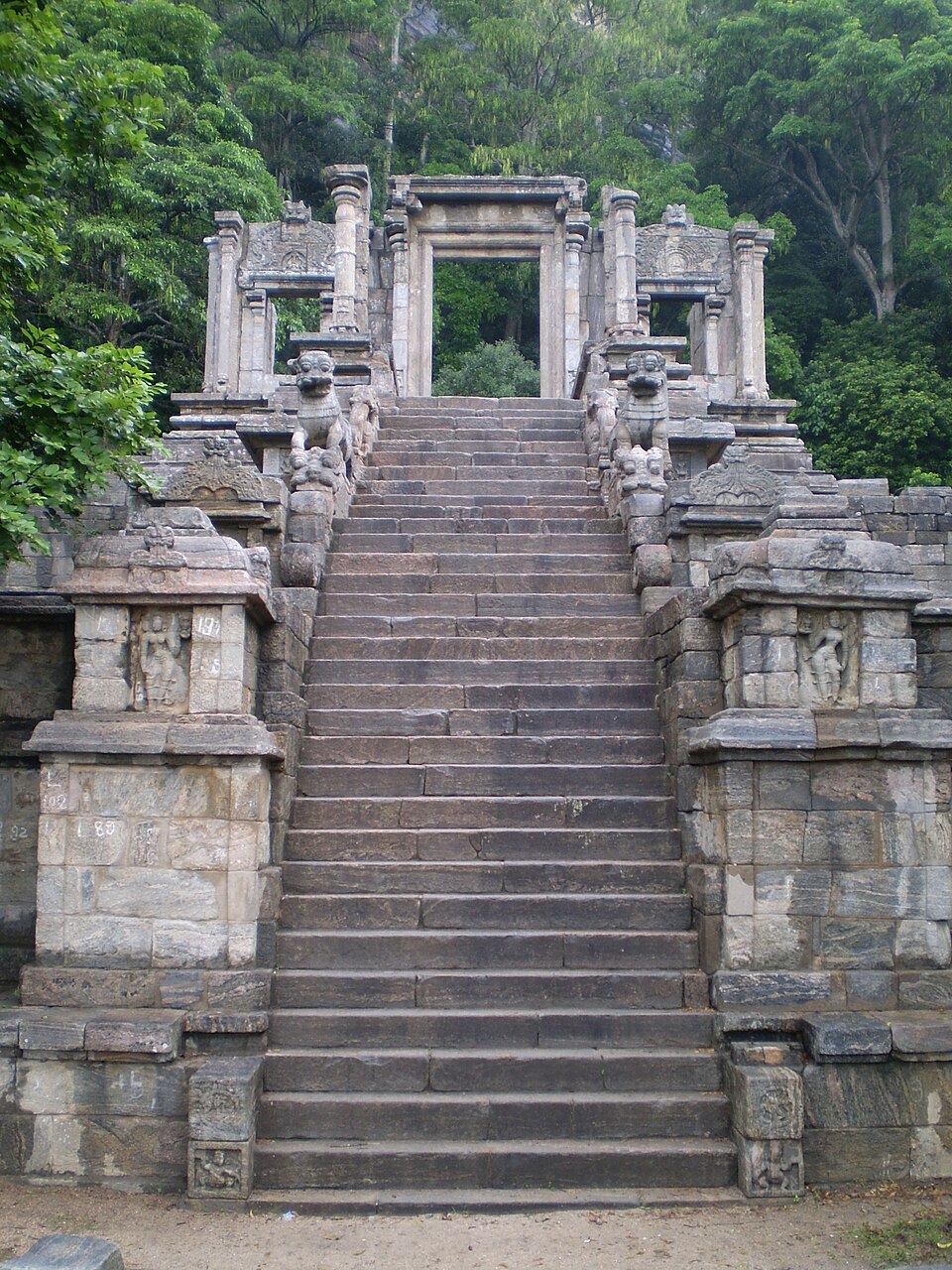
The highlight of Yapahuwa is the steep stone staircase that climbs the side of the rock to the Tooth Relic temple. The upper flight is richly carved, with:
- A pair of carved lions guarding the top of the stairs, among the most famous stone lions in Sri Lanka
- Carved dancers and musicians on the panels beside the steps
- Decorated balustrades and guardstones
- A finely carved doorway and window frames at the top, with delicate stone tracery
The steps are steep and narrow, so take your time and use the handrail where there is one.
The Tooth Relic temple
At the top of the staircase are the ruins of the temple where the Tooth Relic was kept. Only the foundations and carved stonework remain, but standing here, you can imagine the royal ceremonies that once took place.
The summit
From the staircase, a path continues up to the summit of the rock. The climb is steep in places, but the view from the top is wide, across the forests, rice fields and tanks of the dry zone. On a clear day, you can see other rocks rising from the plains. Go early or late in the day, when the light is soft and the rock is cooler.
The cave temple
At the base of the rock, a Buddhist cave temple contains statues and paintings. It is still used for worship, so dress modestly and remove your shoes.
The museum
A small museum near the entrance displays objects found at the site. Ask whether it is open when you arrive.
How to get to Yapahuwa
Yapahuwa is near the town of Maho, in the North Western Province, about halfway between Kurunegala and Anuradhapura. It is a short detour from the main roads to the Cultural Triangle.
By private car
A private driver is the easiest way to visit Yapahuwa, because public transport to the site is limited. Approximate times:
- Kurunegala to Yapahuwa: about 1 to 1.5 hours
- Negombo or Colombo to Yapahuwa: about 3 to 3.5 hours
- Yapahuwa to Anuradhapura: about 1.5 hours
- Yapahuwa to Sigiriya or Dambulla: about 2 to 2.5 hours
Times depend on traffic and the route your driver chooses.
By train and tuk-tuk
Maho is a railway junction on the line from Colombo to the north and east. From Maho, you can take a tuk-tuk to the site, which is a few kilometres away. Check the current timetable before you travel. Check current Sri Lanka Railways service notices before relying on a Colombo connection.
When to visit
Yapahuwa is in the dry zone and can be visited all year. It is usually driest from about January to April and from about June to September. The rock gets very hot in the middle of the day, so go in the early morning or late afternoon. Read our guide to the best time to visit Sri Lanka.
Tickets and opening hours
Foreign visitors need a ticket for the archaeological site. Prices and opening hours can change, so check before your visit. See our guide to entry fees in Sri Lanka.
Combining Yapahuwa with other sites
Yapahuwa is part of a group of lesser-known ancient sites in the North Western Province that are rarely visited by tourists. With a private driver, you can combine it with:
- Padeniya Raja Maha Vihara: a temple with beautifully carved wooden pillars
- Ridi Vihara: a cave temple near Kurunegala, linked to the silver used to build the great Ruwanwelisaya stupa in Anuradhapura
- Panduwas Nuwara: the ruins of an ancient royal city, with a palace and moat
- Arankele: a forest monastery with meditation paths among the trees
See our guide to lesser-known attractions in Sri Lanka and our pages on ancient Buddhist sites and cultural sites in Sri Lanka.
Yapahuwa on the way to the Cultural Triangle
The simplest way to see Yapahuwa is on a travel day. Two common routes:
Negombo to Anuradhapura
Leave Negombo after breakfast, drive north and visit Yapahuwa in the late morning, then continue to Anuradhapura in the afternoon. See our guide to getting from Kandy to Anuradhapura for the area.
Colombo or Negombo to Sigiriya
Take a detour via Kurunegala and Yapahuwa on your way to Sigiriya, instead of going directly. It adds a few hours, but turns a long transfer into a day of sightseeing. See our guide to getting from Colombo to Sigiriya.
Yapahuwa vs Sigiriya
Both are rock fortresses from Sri Lanka's royal past, but they are very different experiences:
| Yapahuwa | Sigiriya | |
|---|---|---|
| Period | 13th century | 5th century |
| Highlight | Carved stone staircase and lions | Frescoes, Lion's Paw entrance, summit palace |
| Crowds | Usually very quiet | Busy, especially in the morning |
| Climb | Shorter, but steep in places | Longer, with many steps |
| UNESCO World Heritage | No | Yes |
If you have time, see both. If you love quiet places and fine stone carving, you will love Yapahuwa. See our guide to Sigiriya vs Pidurangala for more on climbing Sigiriya.
Tips for visiting Yapahuwa
- Go early or late to avoid the midday heat.
- Wear shoes with good grip for the steep steps and rock. You will need to remove them at temple areas.
- Dress modestly, covering your shoulders and knees. See what to wear at Sri Lankan temples.
- Bring water and a hat, as there is little shade on the rock.
- Watch out for monkeys, and don't carry food in your hands.
- Hire a local guide if one is available, to explain the history and carvings. See our private tour guides.
Who Yapahuwa suits
Yapahuwa suits history lovers, photographers and travellers who want to see Sri Lanka's ancient heritage without the crowds. It is a good choice for second-time visitors who have already seen Sigiriya and the main ancient cities. Our cultural tour and 21-day tour can include Yapahuwa, and our Cultural Triangle page covers the wider area.
A sample half-day
- 7:00 am: leave Kurunegala after an early breakfast.
- 8:15 am: arrive at Yapahuwa and climb the stone staircase while it is cool.
- 9:15 am: continue to the summit for the views.
- 10:00 am: visit the cave temple and the museum.
- 10:30 am: continue to Anuradhapura, stopping at Padeniya on the way.
Common mistakes to avoid
- Climbing at midday. The rock and steps get very hot. Go early or late.
- Rushing the staircase. Take time to look closely at the carvings.
- Wearing slippery shoes. The steps are steep and worn.
- Missing it altogether. Yapahuwa is an easy detour on the way to the Cultural Triangle.
Frequently asked questions
Where is Yapahuwa?
Near Maho in the North Western Province of Sri Lanka, between Kurunegala and Anuradhapura.
What is Yapahuwa famous for?
Its ornate stone staircase with carved lions, and its history as a 13th-century royal capital where the Tooth Relic was kept.
How long does it take to visit Yapahuwa?
About two hours, including the staircase, the summit and the cave temple.
Is Yapahuwa difficult to climb?
The steps are steep in places, but the climb is fairly short. Take your time and wear good shoes.
Is Yapahuwa worth visiting?
Yes, especially if you enjoy ancient sites without the crowds. The carvings are among the finest in Sri Lanka.
Can I visit Yapahuwa on the way to Anuradhapura?
Yes. It is an easy stop on a drive from Negombo, Colombo or Kurunegala to Anuradhapura.
Photo sources
- Yapahuwa carved stone staircase and lion sculptures, Sri Lanka — Chindemaya · Public domain · https://commons.wikimedia.org/wiki/File:Yapahuwa_Staricase_2_cdm.jpg