
This guide covers everything you need to plan whale watching in Mirissa: the best months, what you are likely to see, what a trip is really like, what it costs, and how to choose an operator that treats the whales with respect. If you would rather leave the planning to us, our Mirissa whale watching tour includes hotel pickup, a reserved boat seat and a local guide.
Mirissa whale watching at a glance
- Season: November to April (peak December to March)
- Departure: about 6:30am from Mirissa harbour
- Time at sea: usually 3 to 5 hours, sometimes longer
- What you may see: blue whales, sperm whales, Bryde’s whales, spinner and bottlenose dolphins, flying fish and sea turtles
- Typical ticket price: quoted on request; message us for today’s price
- Best for: anyone over about 5 years old who is comfortable on a boat
Why Mirissa is one of the best places in the world to see blue whales
Most of the world’s great whales live far out at sea, so seeing them usually means long boat journeys. Sri Lanka is different. Off the south coast, the continental shelf is very narrow, and the seabed drops to deep water only a short distance from land. That deep water is rich in krill and other food, and it lies on the route whales use as they move between the Arabian Sea and the Bay of Bengal.
The result is that blue whales, the biggest animals on the planet at up to 30 metres long, can often be found within an hour or two of Mirissa harbour. Many of them belong to a population that stays in the northern Indian Ocean all year rather than migrating to polar waters, which is part of why sightings here are so reliable during the season.
The same waters also attract sperm whales, which dive deep to hunt squid, and fast-moving pods of spinner dolphins that can number in the hundreds. For a beach town with palm trees and surf cafes, it is a remarkable place to step onto a boat.
Best time for whale watching in Mirissa: month by month
Whale watching in Mirissa follows the monsoon. When the south-west monsoon brings rough seas from May to October, most boats stop running. When the seas calm from November, the season begins.
| Month | Sea conditions | Whale watching |
|---|---|---|
| November | Calming, some swell | Season starts; sightings building |
| December | Mostly calm | Very good |
| January | Calm | Excellent, a peak month |
| February | Calm | Excellent, a peak month |
| March | Calm, getting hotter | Very good |
| April | Calm early, changeable later | Good, season winding down |
| May to October | Rough, monsoon swell | Few or no trips; consider Trincomalee instead |
If you are visiting between May and October, the east coast is your best option. Read our guide to Trincomalee whale watching, where the season runs from about March to August. For the wider picture of what Sri Lanka is like in the peak months, see our guide to December and January.
What you can see on a Mirissa whale watching trip
No trip comes with a guarantee, because these are wild animals in open water. But in season, most trips from Mirissa see at least one species of whale or a large group of dolphins.
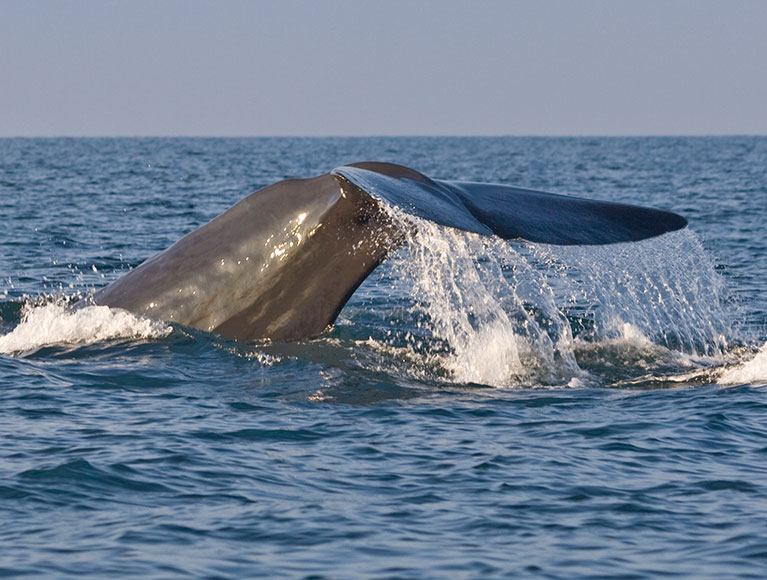
Blue whales. The star of the show. You will usually first spot a tall, straight blow that can reach 9 metres, then a long blue-grey back rolling through the water. If you are lucky, the whale will raise its huge tail flukes before a deep dive.
Sperm whales. Recognisable by their angled, bushy blow and wrinkled skin. They often rest at the surface between long dives, and family groups are sometimes seen with calves.
Bryde’s whales and fin whales. Bryde’s whales are smaller and are seen fairly often. Fin whales are rarer but possible.
Spinner dolphins. Named for their habit of leaping and spinning in the air. Pods can be enormous, and they often ride the bow wave of the boat.
Bottlenose and Risso’s dolphins. Less common than spinners, but regularly recorded.
Other wildlife. Flying fish skim across the surface, and sea turtles and seabirds are common. Very occasionally, boats report orcas or false killer whales.
What a whale watching trip from Mirissa is like
Knowing what to expect makes the day far more enjoyable, especially if you have never been on an ocean boat trip.
Early start. Most boats leave Mirissa harbour at around 6:30am, because the sea is calmest in the early morning. If you are staying in Mirissa or Weligama, you will be picked up or walk to the harbour at about 6am. From Galle or Unawatuna, expect to leave your hotel at around 5:15am.
Heading out. Boats travel south into deep water, often for an hour or more. Crew members watch for blows from the upper deck and talk with other boats by radio to share sightings.
The search. This is the part to be patient about. Whales surface to breathe and then dive for anything from a few minutes to over half an hour. Your crew will position the boat so you can watch when the whale comes up again.
Breakfast and water. Most operators serve a simple breakfast and water on board. Check what is included when you book.
Return. Trips usually return between 10:30am and midday, although a long search can stretch the trip further. You will have the whole afternoon for the beach.
Mirissa whale watching prices and what is included
Prices vary with the size and comfort of the boat, and with whether transport is included.
- Shared boat ticket: price confirmed when you enquire. Usually includes breakfast, water, life jacket and a crew guide.
- Children: child rates are available; tell us your children’s ages when you enquire.
- Private hotel pickup with driver: included in our tour.
- Private boat charter: quoted on request, for families or photographers who want more space.
When comparing prices, ask what is included: breakfast, transfers, insurance, and whether you can go again at a discount if you see no whales. Cheap tickets often mean overcrowded boats. Our Mirissa whale watching tour includes pickup, your boat ticket and a guide, so there are no surprises on the day.
How to choose a responsible whale watching operator
Whale watching should never harm the animals. Sadly, crowded boats chasing whales at speed are a real problem on busy days. Your choice of operator makes a difference.
Look for an operator that:
- keeps a respectful distance and approaches whales slowly from the side, never head-on or from behind
- limits how long boats stay with each whale, and how many boats gather around one animal
- never chases, encircles or cuts off a whale’s path
- uses a seaworthy boat with enough life jackets for everyone, and a toilet on board
- has an experienced crew who can explain what you are seeing
- does not overload the boat to squeeze in extra passengers
If a captain races towards whales or crowds them, it is fine to ask the crew to hold back. Responsible operators will thank you for it. For more on how whale watching works across the island, see our guide to whale watching in Sri Lanka.
Dolphin watching in Mirissa
Many travellers search specifically for dolphin watching in Mirissa, and with good reason. Spinner dolphins are seen on a large share of trips, often in pods of dozens or hundreds. They tend to appear closer to shore than the whales, so you may meet them on the way out or back.
There is no separate dolphin season. Dolphins are seen across the same November to April window as the whales. Any whale watching trip from Mirissa is also a dolphin watching trip.
Seasickness, what to bring and photo tips
The sea off Mirissa can roll, even on calm days, and seasickness is the most common complaint.
To avoid seasickness:
- Take a seasickness tablet about an hour before departure, following the packet instructions.
- Eat a light breakfast before you go; an empty stomach makes nausea worse.
- Sit at the back of the boat on the lower deck, where movement is smallest.
- Look at the horizon rather than at your phone.
What to bring:
- Sunscreen, sunglasses and a hat
- A light jacket or long-sleeved top for the early morning breeze
- Water and a snack
- A camera with a zoom lens, or binoculars
- A small dry bag for your phone and money
Photo tips: Use a fast shutter speed, keep both eyes open so you see the next blow, and try to be ready when a whale lifts its tail before a deep dive.
Combine whale watching with Mirissa, Weligama and Galle
Because trips finish by midday, whale watching fits neatly into a south-coast stay. Spend the afternoon on Mirissa beach, climb Coconut Tree Hill for sunset, or take surf lessons in Weligama, ten minutes away. The next day, explore the ramparts and cafes of Galle Fort.
Mirissa is about 2.5 hours from Colombo on the Southern Expressway. See getting from Colombo to Mirissa for transport options, or browse our Sri Lanka beach holiday packages, which can include whale watching.
Book your Mirissa whale watching trip
Ready to see a blue whale? Book our Mirissa whale watching tour with hotel pickup from Galle, Unawatuna, Weligama or Mirissa, or contact us to add whale watching to a tailor-made Sri Lanka holiday.
Frequently asked questions
Is whale watching in Mirissa worth it?
For most travellers, yes. Seeing a blue whale in the wild is unforgettable, and Mirissa offers some of the most reliable sightings in the world. Be ready for an early start and some time at sea.
Are whale sightings guaranteed?
No. Whales are wild animals. In season, most trips see whales or dolphins, and some operators offer a free or discounted second trip if you see nothing.
Is it suitable for children?
Children from about 5 years old usually enjoy it, but the trip is long and can be rough. Bring snacks, water and something to keep them busy during the search.
What happens if the weather is bad?
Operators cancel trips when the sea is unsafe. You will normally be offered another date or a refund.
Which boat should I choose?
A larger, stable boat with shade, toilets and a responsible-viewing policy is worth paying a little more for.
Mirissa or Trincomalee: which is better?
It depends on your travel dates. Mirissa is best from November to April, and Trincomalee from about March to August.